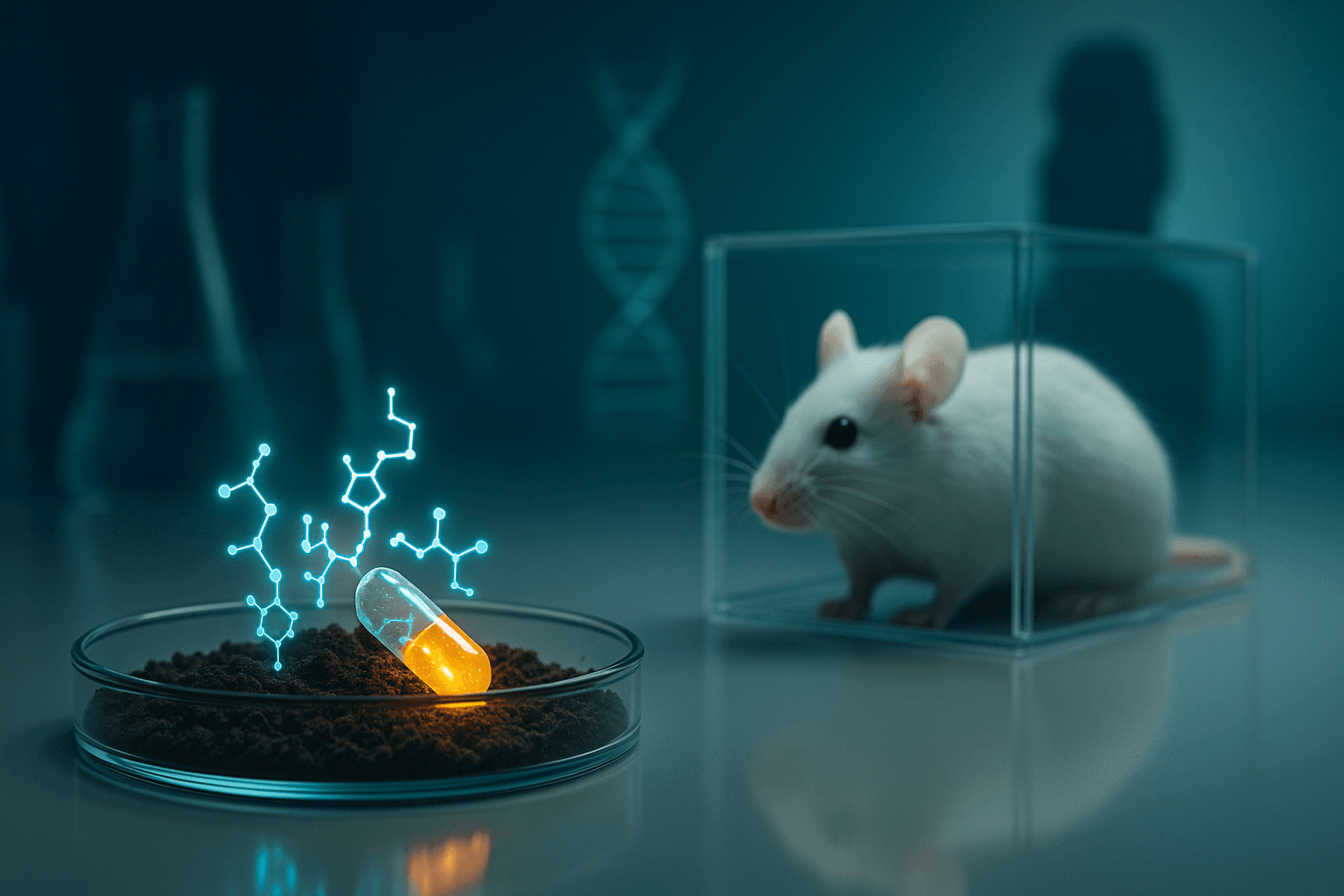
Scientists found rapamycin in island soil. It makes animals live longer, but human data is still early. Here is what we actually know in 2025.
A strange soil sample from Easter Island led to one of the most powerful aging discoveries in modern science. The drug inside that soil, called rapamycin, can extend the lifespan of mice, improve heart function in dogs, and shift old cells into a more youthful repair mode.
🧪 A new 2025 medical review pulled together everything we know so far. It confirms that rapamycin is the strongest lab-tested longevity drug in animals and highlights that hundreds of people are already taking it off-label, hoping to slow their own aging. But the truth is more complicated and far less settled for humans.
Key Takeaways
- Rapamycin extends lifespan in animals, including about 10 percent longer life in mice.
- Small human studies show early benefits, like stronger flu vaccine responses and better skin and health markers.
- Mouth sores are the most common side effect at low doses, and long-term risks in healthy people remain unknown.
- No proof yet that rapamycin extends human life, only hints it may support certain aspects of healthspan.
- Experts say rapamycin should stay in clinical trials until we know safe doses and long-term effects.
The “longevity pill” people are already trying
A 2023 survey looked at 333 adults taking rapamycin off-label for healthspan. Most took around 6 mg once a week, a tiny fraction of transplant doses. Mouth sores were the main extra side effect. Many users said they felt fine, but surveys cannot prove safety or benefit.
📌 A brand new Cureus review (2025) examined rapamycin across 35 studies. It confirmed strong results in animals and suggested early human benefits, but also pointed out the huge gaps in long-term safety for healthy people.
Rapamycin is powerful. People are already using it. Science is still catching up.
The surprising origin story
In the late 1960s, soil from Easter Island revealed a microbe called Streptomyces hygroscopicus. From it, scientists extracted rapamycin. At first it looked like a mild antifungal. Later it became an approved medicine for:
• preventing organ transplant rejection
• treating some rare tumors
• treating a rare lung disease
Then came the shock. Researchers discovered that rapamycin slows aging in almost every lab animal studied.
How rapamycin works inside your cells
Imagine your cells as a busy construction site. One big switch, called mTOR, tells cells to stay in growth mode. Build more. Divide more. Make more proteins.
🔥 When this switch stays on all the time, cells create more “stuff” than they can clean up. Damage piles up.
🧹 Rapamycin turns the switch down. This shifts cells into repair mode, which includes:
• More autophagy, the cell’s clean-up process
• Better quality control of new proteins
• Healthier mitochondria that make cleaner energy
• Calmer inflammation inside tissues
The new review explains rapamycin as a shift from growth toward maintenance, which is one of the reasons it helps animals stay youthful longer.
The animal results are unusually strong
🐁 Mice given rapamycin in mid or late life lived about 10 percent longer on average. Some lived even longer. They also walked better, handled glucose better, and showed fewer age-related problems.
🪰 Fruit flies and worms also lived longer after short rapamycin treatments early in adulthood. In flies, the drug protects the gut and boosts autophagy for months after treatment.
🐕 Dogs receiving low-dose rapamycin showed better heart function in a small study. Larger dog studies are underway.
Across species, rapamycin is the most consistent “longevity drug” ever tested
What rapamycin does for humans so far
This is where the story becomes more cautious.
1. Immune support in older adults
💉 In two randomized trials, adults over 65 took low-dose rapamycin-like drugs for six weeks. They showed:
• Better flu vaccine responses
• Fewer infections over the following year
Side effects were mostly mild. This hints that gentle mTOR inhibition might refresh aging immune cells.
2. Muscle, mood, and daily health
🙂 The PEARL trial followed 114 adults aged 50 to 85 for about a year. Low, intermittent rapamycin improved:
• Lean body mass
• Pain scores in women
• Emotional well-being
• Overall self-rated health
Serious side effects were rare, though mouth sores remained common.
3. Skin aging
🧴 In a small clinical study, rapamycin cream on the skin reduced senescent cells, increased collagen VII, and made treated skin look younger. This might be the clearest visible human result so far.
📌 Important: No study has shown that rapamycin can help humans live longer. We only have hints that it might help certain systems function better for a short time.
The Bryan Johnson cautionary tale
⚠️ Tech entrepreneur Bryan Johnson used rapamycin for years as part of his intense longevity routine. In 2025, he publicly said he stopped after dealing with infections, higher blood fats, higher blood sugar, and a faster heart rate. His case highlights something experts already know.
Rapamycin helps. Rapamycin can also cause harm. Dose, timing, and overall health matter.
The real risks you need to know
🚫 At medical doses used for transplants, rapamycin can cause:
• Mouth sores
• High cholesterol
• High blood sugar
• More infections
• Slow wound healing
These patients are already fragile, but the risks are well documented.
At low weekly doses, the side effects look lighter:
• Mouth sores are still common
• Some people see higher cholesterol or glucose
• Infections might rise slightly
• Most effects reverse when the drug is stopped
📌 What we do not know is the most important part. We do not know the effect of 10 or 20 years of low-dose rapamycin in healthy people.
What scientists say right now
Researchers agree on two things:
- Rapamycin is the strongest anti-aging compound ever tested in animals.
- Humans need much better data before using it widely.
Experts still do not know:
• The safest dose
• The best schedule
• Who benefits most
• How long it is safe to take
• Whether it can really extend human life
🧬 Until these questions are answered, rapamycin remains a scientific tool, not a casual longevity pill.
The bottom line for regular people
🏃♂️ The best proven longevity tools are still the basics. Exercise, good sleep, real food, and not smoking affect many of the same aging pathways as rapamycin and come with far fewer risks.
Rapamycin is different. It is a prescription drug that:
• Makes many animals live longer
• Shows early, promising results in humans
• Carries real, measurable risks
• Has unknown long-term effects in healthy people
If you are curious, the safest option is joining a clinical trial where doctors monitor every step. Buying rapamycin online or experimenting without guidance is not the same thing.
The Easter Island pill may one day help humans age more slowly. For now, it is still an open experiment and not a magic key.
Sources
- Zerdka J et al. The Mechanistic Target of Rapamycin (mTOR) Pathway as a Target of Anti-aging Therapies. Cureus, 2025.
https://doi.org/10.7759/cureus.98514 - Harrison DE et al. Rapamycin fed late in life extends lifespan in genetically heterogeneous mice. Nature, 2009.
https://www.nature.com/articles/nature08221 - Mannick JB et al. mTOR inhibition improves immune function in the elderly. Sci Transl Med, 2014.
https://www.science.org/doi/10.1126/scitranslmed.3009892 - Moel M et al. Influence of rapamycin on safety and healthspan metrics after one year: PEARL trial results. Aging, 2025.
https://doi.org/10.18632/aging.206235 - Kaeberlein TL et al. Evaluation of off-label rapamycin use to promote healthspan in 333 adults. Geroscience, 2023.
https://doi.org/10.1007/s11357-023-00818-1