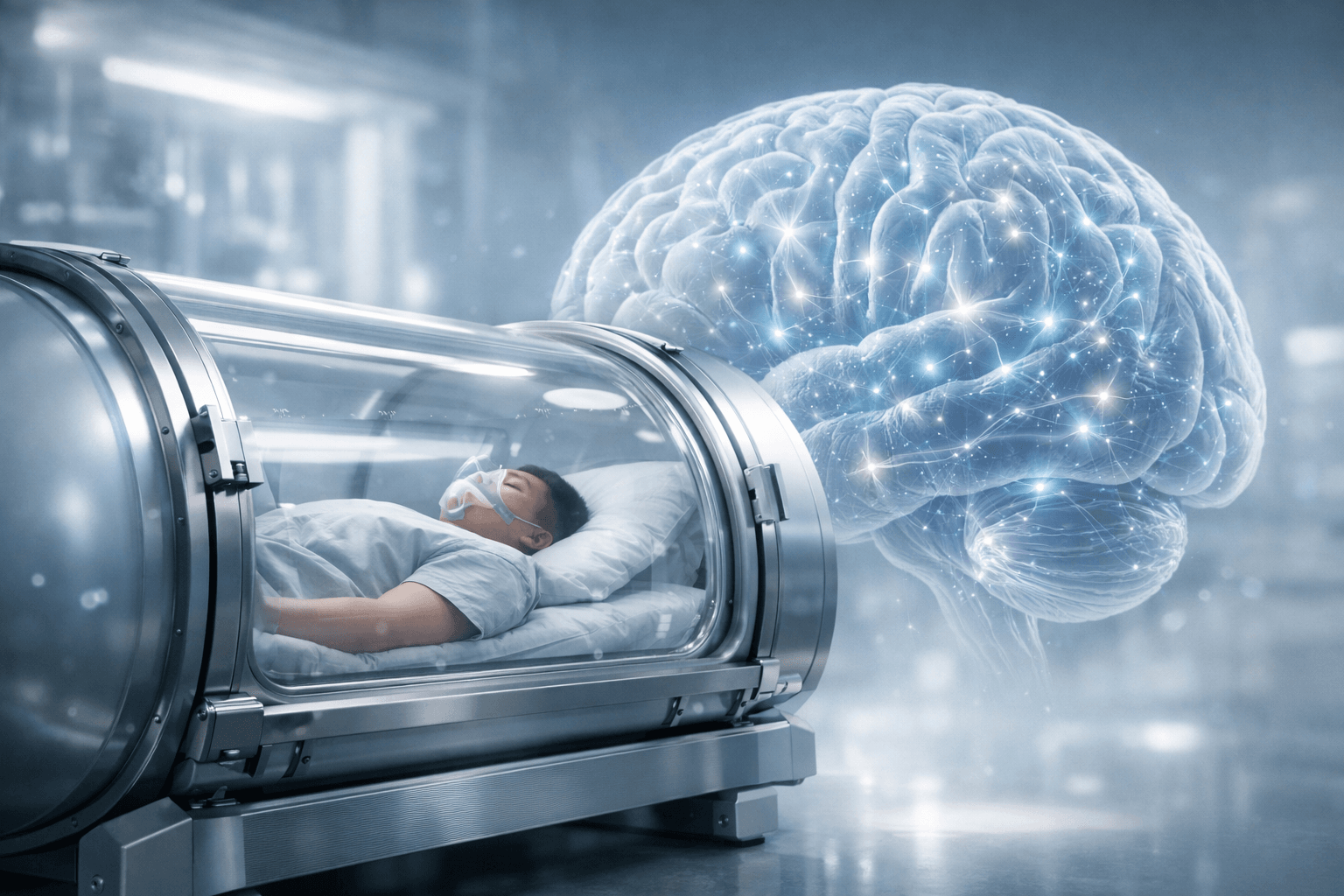
A closer look at how increased oxygen pressure activates stem-cell pathways, lengthens telomeres, and restores cognitive performance in aging brains.

Breathing pure oxygen in a pressurized chamber does more than heal wounds, it can reverse cellular aging, enhance cognitive function, and trigger neuroplasticity that lasts for years. Here’s what the latest science shows about HBOT’s impact on your brain and longevity.
Key Takeaways
- How HBOT increases telomere length by over 20% and clears senescent cells
- Why neuroplasticity improvements persist for 2+ years after treatment
- The specific pressure protocols that trigger brain regeneration
- What 2025 clinical trials reveal about PTSD, long COVID, and cognitive decline
What Is HBOT and How Does It Work on Your Brain?
Hyperbaric Oxygen Therapy (HBOT) involves breathing 100% pure oxygen inside a pressurized chamber at 1.5-2.0 ATA (atmospheres absolute)—about the pressure you’d experience 16-33 feet underwater.
The Dual Mechanism That Powers Regeneration
🔬 Hyperoxia Effects: Your blood plasma carries 10-15x more oxygen than usual, reaching tissues that normally receive limited blood flow.
⚡ Pressure Effects: The increased atmospheric pressure independently activates pressure-sensitive genes, enhancing regenerative potential.
“Increasing oxygenation to supraphysiological levels by breathing 100% oxygen under hyperbaric pressure activates oxygen and pressure sensitive genes, leading to neurological function improvements.”
Recent 2025 research demonstrates a linear dose-response relationship, more pressure and oxygen equals better outcomes across pressures from 1.3 to 2.0 ATA.
The Breakthrough: HBOT Reverses Cellular Aging
Studies from 2024-2025 show HBOT can induce significant senolytic effects, reversing biological markers of aging at the cellular level.
What Happens to Your Cells
📊 Telomere Lengthening:
- T helper, T cytotoxic, NK, and B cells increased by over 20%
- B cells showed the most dramatic changes: up to 37.63% increase
- Changes measured at 30th and 60th sessions
🧹 Senescent Cell Clearance:
- T helper senescent cells decreased by 37.30%
- T-cytotoxic senescent cells decreased by 10.96%
- These dysfunctional “zombie cells” contribute to age-related decline
Telomeres are protective caps on chromosomes that naturally shorten 20-40 bases yearly. Senescent cells stop dividing but don’t die, accumulating and causing inflammation. HBOT reverses both markers, your cells become measurably younger.
What 2024-2025 Studies Reveal About HBOT
Recent clinical trials have dramatically expanded our understanding of HBOT’s therapeutic potential.
Long COVID: Sustained Improvements One Year Later
A 2024 longitudinal study evaluated 31 patients more than one year after completing HBOT. The findings: quality of life improvements were similar in magnitude to short-term outcomes.
Key Improvements:
- Cognitive function (attention, executive function)
- Sleep quality across five domains
- Energy levels and daily functioning
- Pain reduction
- Psychiatric symptoms (mood, anxiety)
A separate 2025 prospective registry of 232 patients showed beneficial effects on physical and mental component scores.
PTSD: 68% Show Major Symptom Reduction
A 2024 study on combat-associated PTSD found:
- 68% showed ≥30% reduction in symptoms
- 39% achieved complete remission
- Follow-up of 22 veterans showed sustained improvements ~704 days post-HBOT
Even more remarkable: these were treatment-resistant cases that hadn’t responded to conventional therapies.
Stroke and TBI: Recovery Years After Injury
Over two decades of research demonstrates HBOT’s efficacy in reducing cerebral infarct volume. Most importantly, improvements occur even years after the initial injury, suggesting impaired tissue perfusion may limit regeneration long after acute injury.
How HBOT Triggers Neuroplasticity: The Six Core Mechanisms
HBOT affects multiple cellular functions simultaneously, creating a comprehensive regenerative environment.
The Pathways HBOT Activates
1. 🔋 Mitochondrial Enhancement
10-14 days of HBOT increases ATP production and reduces cellular death signaling. Your cellular powerhouses work more efficiently.
2. 🧬 Stem Cell Activation
Mobilizes bone marrow stem cells to areas of brain injury, facilitating cellular repair.
3. 🩸 Angiogenesis
50-70 daily sessions significantly increase cerebral blood flow and volume, improving oxygen delivery.
4. 🌱 Neurogenesis
Stimulates creation of new neurons in regions critical for memory and learning.
5. 🔗 Synaptogenesis
Brain MRI shows microstructural changes in the insula, supramarginal, and inferior frontal gyri—evidence of new neural connections.
6. 🛡️ Anti-Inflammatory Action
Lowers pro-inflammatory cytokines, creating a neuroprotective environment.
The Optimal Protocol: What Actually Works
Not all HBOT protocols produce results. Effectiveness depends on pressure, oxygen concentration, duration, and total sessions.
Evidence-Based Protocol Range
Based on 2025 systematic reviews:
Typical Effective Protocols:
- Pressure: 1.5-2.0 ATA
- Oxygen: 100% pure oxygen
- Duration: 60-90 minutes per session
- Frequency: 5 days per week
- Total sessions: 40-60 over 2-3 months
The “Hyperoxic-Hypoxic Paradox”
Fluctuating between elevated and normal oxygen levels triggers stem cell activation, angiogenesis, and mitochondrial repair. This explains why intermittent protocols outperform continuous oxygen supplementation.
“The combined action of hyperoxia and hyperbaric pressure leads to significant improvement in tissue oxygenation while targeting both oxygen and pressure sensitive genes.”
What You Can Expect: Timeline of Results
Weeks 1-4: Early Changes
- ✅ Increased energy
- ✅ Better sleep quality
- ✅ Reduced brain fog
- ✅ Enhanced mood
Months 2-3: Measurable Improvements
- ✅ Cognitive gains: Processing speed, memory, executive function
- ✅ Physical changes: Increased stamina, reduced pain
- ✅ Cellular changes: Telomere lengthening visible at sessions 30 and 60
6+ Months Post-Treatment: Long-Term Benefits
- ✅ Sustained neuroplasticity: Benefits maintain similar magnitude
- ✅ Durable symptom relief: Effects persist beyond treatment period
- ✅ Brain structure changes: MRI-visible connectivity improvements
Who Benefits Most from HBOT?
Based on strongest clinical evidence from 2024-2025:
Established Indications
✅ Long COVID Patients
232-patient registry showed beneficial effects on physical and mental scores
✅ PTSD (Especially Veterans)
68% response rate with sustained improvements ~2 years post-treatment
✅ Stroke Recovery
Effectiveness even 3-10 years post-injury
✅ Age-Related Cognitive Decline
Reverses markers of cellular aging in healthy adults
✅ Chronic Brain Injury
Evidence of recovery capacity far longer than previously believed
Safety Update: Cancer Concerns Addressed
A 2025 safety evaluation found no evidence HBOT contributes to tumor progression, recurrence, or metastasis.
Key Findings
Study Details:
- Cancer patients undergoing HBOT
- Median follow-up: 783 days
- 18.6% had active cancer at initiation
Results:
- 0% HBOT-related complications
- No significant correlations between sessions and metastasis or mortality
- 59.5% had no recurrence
2025 reviews note HBOT can enhance cancer immunotherapy and improve radiotherapy effectiveness.
Understanding Potential Side Effects
Common (Usually Mild)
- 👂 Ear pressure (like airplane descent)
- 👁️ Temporary vision changes
- 😴 Fatigue after initial sessions
Rare but Important
- Oxygen toxicity: 30-39% experience reversible emotional symptoms at highest doses
- Cataracts: Reported after 100+ sessions in some cases
Contraindications
❌ Untreated pneumothorax
❌ Severe claustrophobia
❌ Recent ear surgery
❌ Certain lung conditions
The $28 Million Trial That Could Change Everything
USF Health launched a $28 million state-funded clinical trial—one of the most rigorous HBOT studies ever conducted.
What Makes It Significant:
- ⏱️ Five-year duration
- 🔬 Randomized, double-blind, placebo-controlled
- 🎖️ Focused on Florida service members and veterans with TBI
- 📊 Comprehensive monitoring of blood, oxygen, brain levels
Results could reshape HBOT's role in treating neurological diseases.
How to Access HBOT: What You Need to Know
Medical HBOT Centers ✅
Look for:
- UHMS (Undersea and Hyperbaric Medical Society) affiliation
- Hospital-based hyperbaric medicine departments
- Board-certified hyperbaric physicians
- FDA-cleared chambers (1.5-2.0+ ATA)
- 100% oxygen delivery
Wellness Spas ⚠️
As of 2025, hundreds to thousands of wellness spas offer HBOT, growing 30-50% since 2020.
Critical Limitations:
- ❌ Often use “mild” chambers (≤1.3 ATA)
- ❌ May not deliver pure oxygen
- ❌ Providers often not medical professionals
- ❌ Protocols not research-based
“Safety is paramount and should be optimized through collaboration with scientific organizations that have subject matter experts in diverse hyperbaric technical expertise.”
Your HBOT Evaluation Checklist
Before pursuing treatment, verify:
Essential Requirements
- Medical oversight: Board-certified hyperbaric physician
- Proper equipment: Chambers capable of 1.5-2.0+ ATA
- Pure oxygen: 100% oxygen delivery (not compressed air)
- Evidence-based protocols: Following published research
- UHMS accreditation: Facility certification
Red Flags to Avoid
- 🚩 Claims of miracle cures
- 🚩 “Mild” hyperbaric chambers only (1.3 ATA)
- 🚩 No medical doctor involvement
- 🚩 Aggressive marketing without scientific backing
- 🚩 No patient screening for contraindications
Your Questions About HBOT Answered
How Long Do the Benefits of HBOT Last After Treatment?
Follow-up studies show improvements maintain similar magnitude one year after completion. For PTSD, sustained benefits observed ~704 days post-HBOT. The neuroplasticity changes appear to be durable, not temporary.
Is HBOT Covered by Insurance?
Currently covered for FDA-approved conditions:
- Wound healing
- Carbon monoxide poisoning
- Decompression sickness
Not typically covered (yet):
- Cognitive enhancement
- Long COVID
- PTSD
- Age-related decline
Coverage policies are evolving as evidence accumulates.
How Many Sessions Do You Need?
Most neuroplasticity protocols involve:
- 40-60 sessions total
- 5 days per week
- 2-3 months duration
Telomere studies used 60 daily exposures with measurements at baseline, session 30, session 60, and post-treatment.
Can You Do HBOT at Home?
Portable chambers typically provide only mild pressure (1.3 ATA) and may not deliver pure oxygen. The protocols proven effective in research require medical-grade equipment and supervision. Home units haven’t been validated in clinical trials for neuroplasticity.
What’s the Difference Between 1.3 and 2.0 ATA?
1.3 ATA (“mild” hyperbaric):
- Available in wellness spas
- Limited research support
- May not trigger full regenerative response
1.5-2.0 ATA (medical-grade):
- Used in clinical trials
- Proven neuroplasticity effects
- Linear dose-response relationship
Higher pressure within safe limits appears more effective.
The Future: What 2026 and Beyond May Bring
A 2025 editorial in Frontiers in Neurology emphasizes understanding dose-response relationships for both pressure and hyperoxia.
Emerging Research Directions
🔬 Personalized Protocols
Identifying optimal pressure, oxygen, and frequency based on genetics and condition
🤝 Combination Therapies
HBOT with chemotherapy, immunotherapy, and other interventions
🧠 Cognitive Enhancement
Beyond treating disease—optimizing healthy brain performance
⏳ Longevity Medicine
Telomere and senescent cell findings position HBOT as preventive aging intervention
The Bottom Line on HBOT
Every HBOT session isn’t just delivering oxygen—it’s triggering a cascade of regenerative processes that can reverse cellular aging, enhance brain function, and create lasting neuroplastic changes.
The research from 2024-2025 has moved HBOT from experimental to evidence-based for specific conditions. The key is finding proper medical facilities, following research-backed protocols, and maintaining realistic expectations.
You don’t need to understand all the mechanisms. You need to know that your brain retains remarkable capacity for regeneration—even years after injury or age-related decline.
🎯 And HBOT may be one of the most powerful tools we have to unlock it.
Sources
- Hyperbaric oxygen therapy increases telomere length and decreases immunosenescence in isolated blood cells: a prospective trial
https://pubmed.ncbi.nlm.nih.gov/33206062/ - Hyperbaric oxygen therapy improves post-COVID condition: longitudinal outcomes in a 2025 trial
https://www.nature.com/articles/s41598-025-11539-0 - Hyperbaric Oxygen Therapy for PTSD: Threshold Effect for Neuroplasticity
https://pmc.ncbi.nlm.nih.gov/articles/PMC12373514/