How Animals That Regrow Limbs and Bodies Could Transform Human Longevity and Healing.
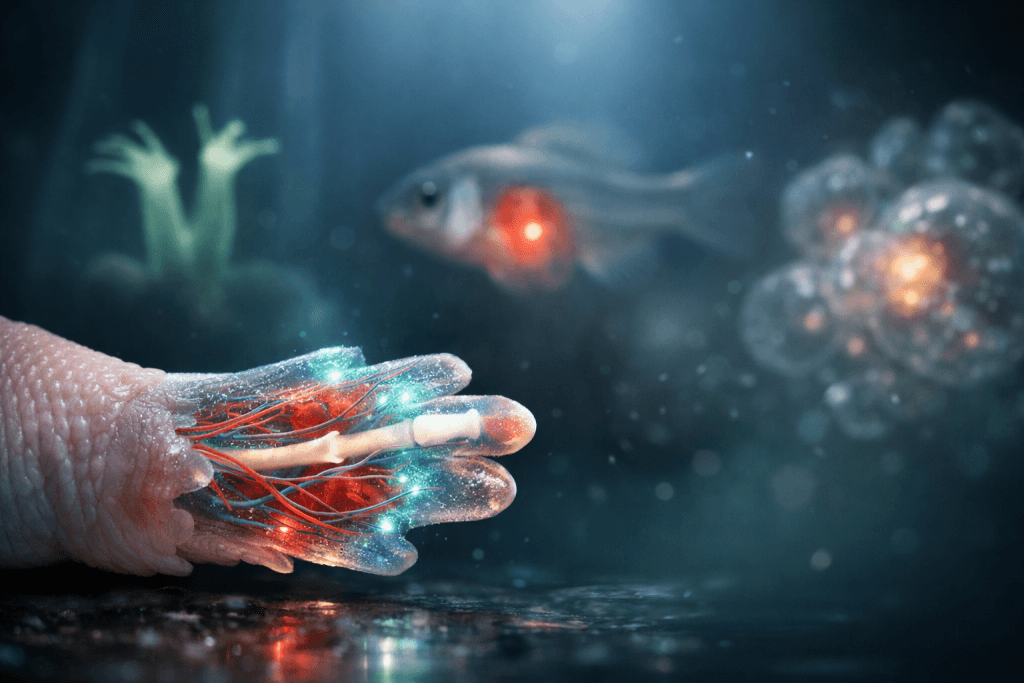
Imagine regrowing a lost finger, healing spinal injuries, or reversing age-related tissue damage. That sounds like science fiction. But in nature, some animals already do this every day.
From tiny Hydra that rebuilds itself from fragments to salamanders that perfectly regrow limbs, nature has evolved blueprints for scar-free healing and tissue regeneration. Now, cutting-edge research is uncovering the molecular and cellular secrets that could eventually let humans tap into our own dormant regenerative potential.
For biohackers and longevity seekers, these discoveries offer a glimpse into the future of health, and strategies to slow aging and enhance recovery today.
Key Takeaways
- Regeneration exists on a spectrum: Some animals rebuild entire bodies from pieces, others specific organs or tissues.
- Senescent cells aren’t always bad: In regenerators like axolotl, they trigger growth instead of decline.
- Regenerative signaling is the key: Molecules that control positional memory and growth could be targeted in humans.
- Human healing vs. regeneration: We heal by scar formation, but research aims to shift that toward restoration.
The Champions of Regeneration
Axolotls: the gold standard of regeneration
The axolotl, a salamander native to Mexico, is the most famous regenerator on Earth. Lose a leg, tail, or part of the spinal cord, and it grows back exactly as before. Bones, muscles, nerves, blood vessels, even skin patterns return flawlessly. No scarring. No deformities.
What makes axolotls extraordinary is not just what they regrow, but how. After injury, mature cells near the wound dedifferentiate, reverting to a flexible, stem-like state. These cells form a structure called the blastema, which acts like a temporary growth factory. From there, precise molecular gradients tell cells what to become and where to go.
Recent research shows that retinoic acid signaling acts like a GPS system, helping cells know whether they are rebuilding a hand, an elbow, or a shoulder. This positional memory is something humans largely lack once development ends.
🦎 Even more surprising, axolotls use temporary cellular senescence during regeneration. In humans, senescent cells are associated with aging and disease. In axolotls, they appear briefly, release growth signals, and are then efficiently cleared by macrophages. The result is regeneration, not decline.
Planarian flatworms: regeneration without limits
Cut a planarian flatworm into ten pieces, and you get ten complete animals. Some species can regenerate from fragments smaller than one percent of their original body.
This is possible because planarians maintain a large population of pluripotent adult stem cells, called neoblasts. These cells can become any tissue type at any time. Unlike human stem cells, they never seem to lose this flexibility.
Even more fascinating, studies suggest that planarians may retain learned behaviors after regeneration. That raises profound questions about where memory is stored and how biological information survives massive physical reconstruction.
🪱 For longevity science, planarians show what happens when stem cell exhaustion never occurs, a major driver of aging in humans.
Hydra: the animal that may never age
Hydra are tiny freshwater polyps that look almost too simple to matter. Yet they may hold one of the biggest secrets in biology.
Under stable conditions, hydra show no measurable aging. Their mortality rate does not increase over time. Their bodies constantly renew themselves through continuous cell division, replacing every cell every few weeks.
Hydra do not rely on a central stem cell niche. Instead, their entire body acts as a self-renewing system. Damaged parts regenerate automatically, and even small fragments can grow into full organisms.
🧬 This makes hydra a powerful model for studying biological immortality, not in the science-fiction sense, but as sustained tissue renewal without decline.
Zebrafish: the heart-healing fish
Zebrafish can regenerate up to 20 percent of their heart tissue after injury. They also repair spinal cord damage, retinal neurons, and fins.
Instead of forming scar tissue after heart injury, zebrafish activate regenerative pathways that cause existing heart cells to re-enter the cell cycle and divide. The damaged area is replaced with functional muscle, not fibrotic tissue.
🐟 This ability has made zebrafish a cornerstone of cardiovascular research. Many drug targets now being explored for human heart regeneration were first identified in zebrafish models.
Sea stars, sea cucumbers, and salamanders
Sea stars can regrow arms, and in some species, a single arm plus part of the central disc can regenerate an entire animal. Sea cucumbers eject internal organs as a defense mechanism and regenerate them later.
Most salamanders, not just axolotls, retain lifelong regenerative ability. Limbs, tails, jaws, and parts of the eye can all be rebuilt repeatedly.
🦌 Even mammals show hints of regeneration. Deer regrow antlers every year, the fastest-growing tissue in any mammal. Antlers are not simple bone. They are complex organs with nerves, blood supply, and skin.
Why These Animals Can Regenerate
🧠 Controlled inflammation
In humans, injury triggers inflammation that often overshoots, leading to fibrosis and scarring. Regenerative animals tightly control inflammatory responses, allowing healing signals without long-term damage.
🧬 Cellular plasticity
Regenerators either maintain large stem cell populations or can revert mature cells to a flexible state. Humans largely lock cells into specialized identities.
🧫 Efficient senescent cell clearance
Temporary senescence can promote regeneration, but only if senescent cells are removed quickly. Macrophages play a critical role here. In aging humans, this clearance often fails.
🧭 Reactivated developmental programs
Regeneration often reuses genetic programs from embryonic development. Humans shut most of these programs down permanently after birth.
Why Humans Heal Instead of Regenerate
🧠 Humans are not completely incapable of regeneration. The liver can regrow after injury. Skin and blood renew constantly. Children can regenerate fingertip tissue under the right conditions.
But compared to regenerative animals, humans prioritize speed and cancer prevention over perfect reconstruction. Scar formation is fast and protective, but it sacrifices function.
Rapid cell division increases cancer risk. Evolution appears to have traded regenerative power for long-term stability and complexity. That trade-off favored survival and reproduction, not longevity or recovery optimization.
What Regeneration Teaches Biohackers and Longevity Seekers
🧬 Senescence is context-dependent
The goal is not zero senescent cells. It is the right cells at the right time, followed by efficient clearance. This nuance is increasingly shaping senolytic research.
🔥 Inflammation management is foundational
Chronic inflammation blocks regeneration. Sleep, nutrition, exercise, and stress control are not just wellness habits. They directly influence tissue repair capacity.
🧪 Recovery signaling matters as much as damage
Growth factors, mechanical loading, and metabolic state determine whether tissue heals or degrades. Regeneration research reinforces the importance of recovery cycles in training and health optimization.
🧠 Aging may be partially reversible at the tissue level
If cells can be safely nudged into youthful programs without losing control, aging becomes a modifiable process, not a fixed trajectory.
The Future of Regenerative Medicine
🔬 Scientists are already experimenting with ways to activate dormant regenerative pathways in mammals. Early successes include improved wound healing, reduced scarring, and partial tissue restoration in animal models.
Heart repair, spinal cord recovery, and organ regeneration remain difficult, but progress is accelerating. Each insight from axolotls, hydra, and zebrafish brings human regeneration closer to reality.
Regeneration is not magic. It is biology we forgot how to use.
Sources
- How axolotls regenerate limbs with positional memory
https://news.northeastern.edu/2025/06/10/axolotl-limb-regeneration/ - Senescent cells are essential for axolotl limb regeneration
https://tu-dresden.de/tu-dresden/newsportal/news/senescent-cells-key-to-axolotl-limb-regeneration - Planarian stem cells and whole-body regeneration
https://onlinelibrary.wiley.com/doi/10.1111/cpr.13276 - Biological immortality and hydra aging research
https://en.wikipedia.org/wiki/Biological_immortality