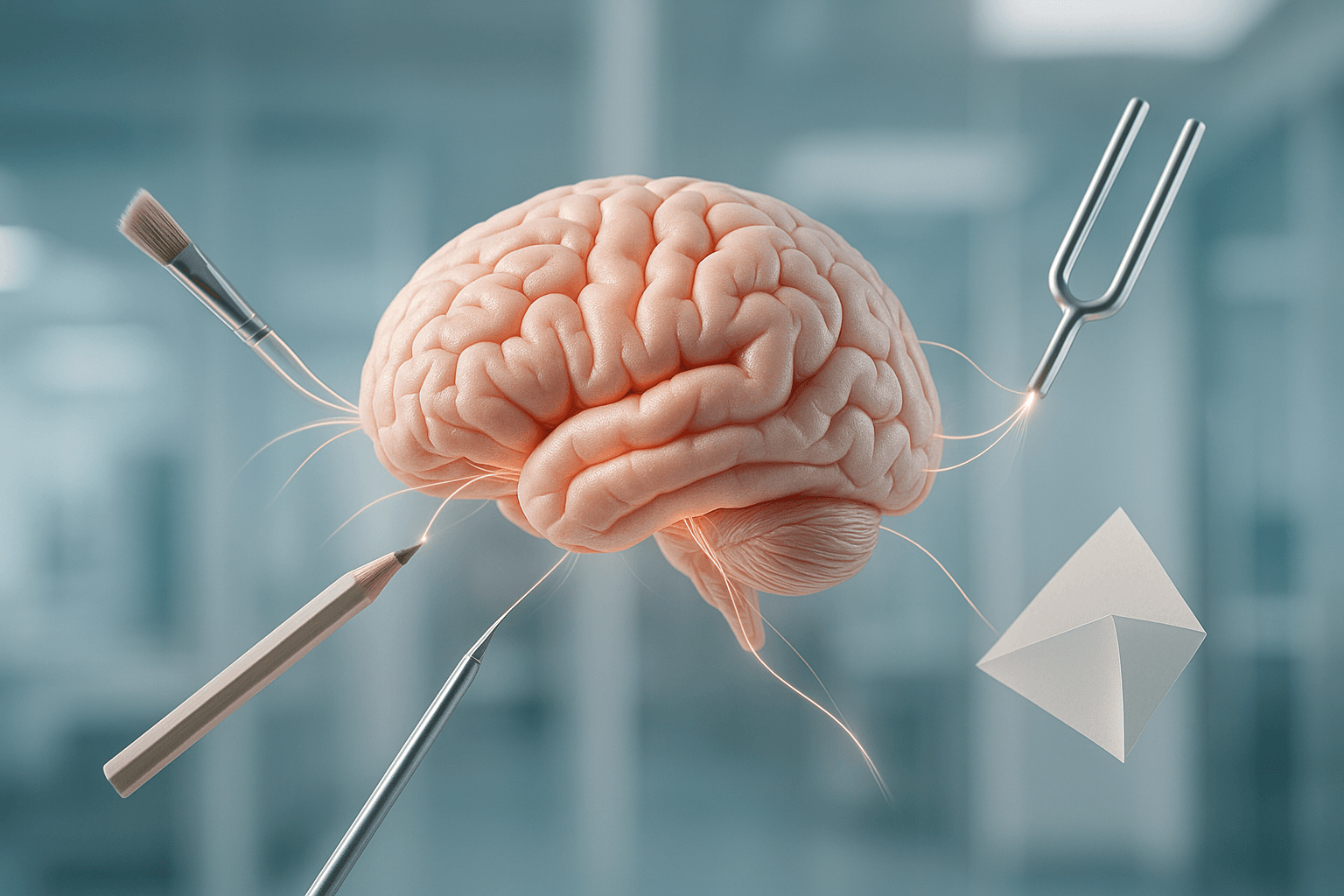
New research suggests that creative hobbies and skills help keep brain networks healthier as we age.
A major study in Nature Communications reports a surprising finding. People who dance, draw, play music, or train in strategy video games show younger and healthier brain activity than people who do not.
The researchers used brain recordings to predict each person’s brain age, then compared it with their real age. Experts in every creative field looked several years younger in brain function.
Even beginners who trained a strategy game for only 30 hours showed a clear drop in predicted brain age.
The results suggest creativity may act as a simple and accessible tool for brain health.
Key Takeaways
- Creative experts showed younger brain ages across dance, music, drawing, and gaming.
- Short training helped too. Thirty hours of StarCraft II reduced predicted brain age by about 3 years.
- These changes matched stronger and more efficient brain connections in areas that usually age faster.
- Skill level mattered. People with higher expertise or faster gameplay had the youngest brain signatures.
- The study hints that creative activities may protect brain health, similar to exercise or learning.
How creativity shows up in the brain
Stronger networks that resist aging
The study used EEG and MEG to measure functional connectivity, a way to see how well different brain regions communicate.
Experts in every creative domain had tighter and more efficient networks, especially in the frontoparietal region. This area often shows early aging because it handles planning, attention, and complex movement.
A useful number to remember is this: creative experts showed brain ages that were 4 to 7 years younger than their real age.
Higher local efficiency meant their brains moved information more quickly and with less effort. That pattern is linked with better thinking, healthier aging, and stronger cognitive reserve.
What short training can do
The learning study asked adults to train the strategy game StarCraft II for 30 hours. After training, their predicted brain age dropped by about 3 years. People who improved their actions per minute showed the biggest change.
A separate group played Hearthstone and did not show this drop. This suggests the effect came from active skill learning, not simply playing a game.
Short training improved local efficiency, which supports quick information flow. It did not change global coupling, which reflects whole-brain stability. That deeper shift appeared only in long-term experts. This fits a simple idea.
Learning helps quickly. Expertise helps deeply.
Why these brain changes matter
A healthier, more resilient network
Across all groups, the researchers saw the same pattern. Creative experiences boosted:
- Functional connectivity
- Local and global efficiency
- Biophysical coupling strength in experts
These are all signs of a resilient brain. They help protect attention, memory, and coordination as we age.
A separate analysis looked at which mental skills were linked to the stronger connections. The patterns matched each field.
- Dancers showed networks linked to motor control and imagery.
- Musicians showed networks linked to hearing and timing.
- Artists showed networks linked to visual and motor planning.
- Strategy gamers showed networks linked to attention and decision making.
This points to a simple rule. The brain gets stronger in the areas you use with purpose and creativity.
Why creativity matters for public health
Creativity acts like lifestyle medicine
This study places creativity next to exercise, social engagement, and education as a modifiable lifestyle factor that may support healthy aging.
Creative activities do not require talent. They require practice, curiosity, and time.
Because dancing, drawing, and gaming can be taught in community centers, schools, and clinics, they offer a low cost and scalable tool for brain wellness.
One example is community dance programs for older adults. These classes offer movement, rhythm, challenge, and social contact. Each of these ingredients supports brain network resilience.
What we still do not know
The expertise results were cross sectional, which makes it hard to prove cause and effect. Sample sizes were small in some training groups and predicted brain age is helpful but not a full picture of cognitive health.
We also do not know which parts of creativity have the strongest impact. It could be novelty, emotional expression, practice intensity, or high focus.
More long term studies will be needed to confirm how creative habits protect the brain over decades.
The bottom line
Creative activities do more than enrich life. They appear to strengthen the very brain networks that age the fastest.
This study suggests creativity is not a luxury. It is a practical tool for lifelong brain health, and anyone can begin at any age.
Sources
- Creative experiences and brain clocks. Nature Communications. 2025.
https://doi.org/10.1038/s41467-025-64173-9