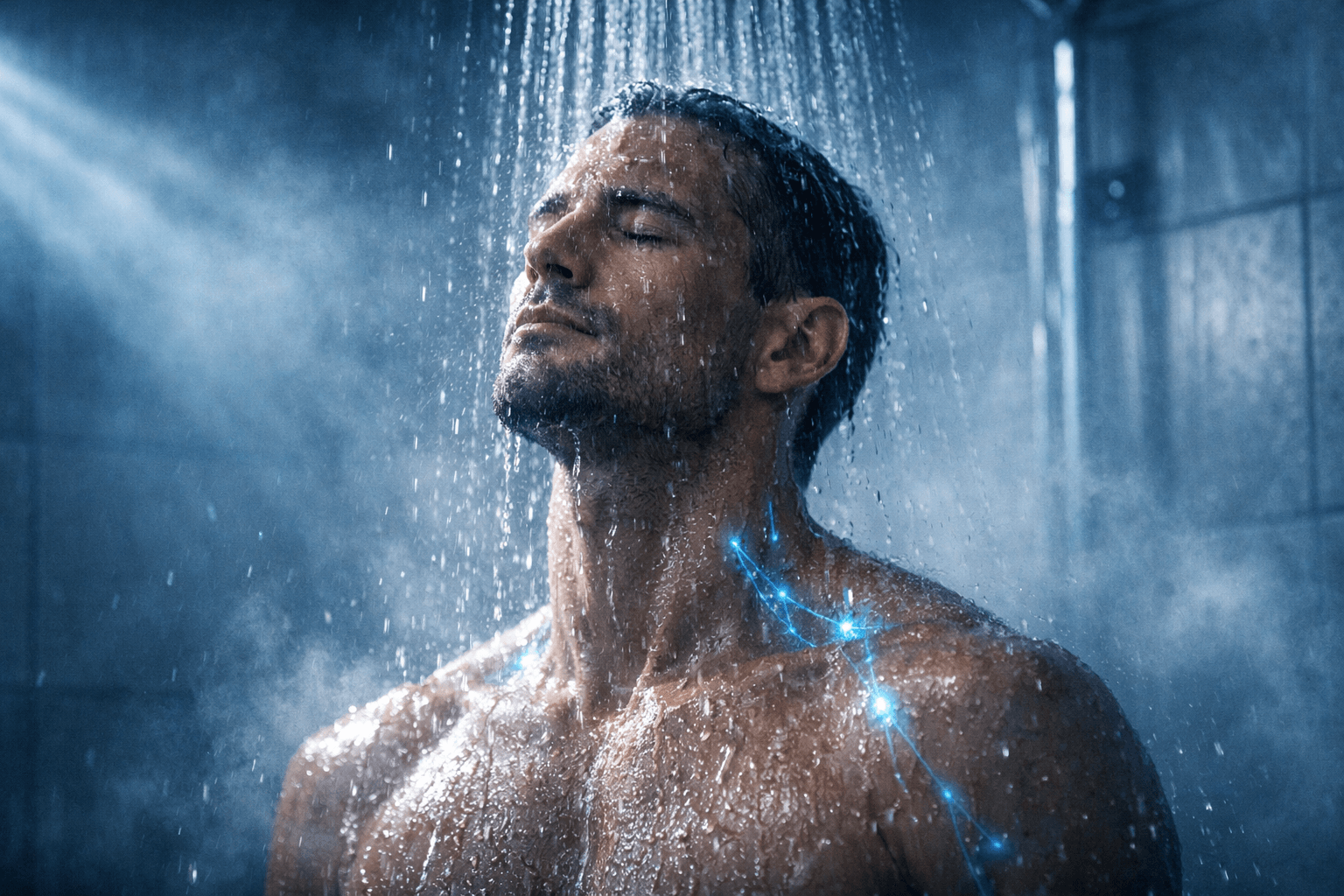
A few minutes of cold can change your mood, brain-network wiring, and stress chemistry. But timing and technique matter more than the internet admits.
Cold showers have gone from niche biohacking ritual to mainstream wellness advice. Scroll long enough and you’ll hear they boost dopamine, harden your mind, burn fat, and cure modern malaise. That sounds like internet exaggeration. But the science published over the last few years tells a more nuanced and genuinely fascinating story.
The short version: cold exposure does something real to your brain and chemistry, but not in the simplistic “dopamine hack” way it’s often framed.
Key Takeaways
- Cold exposure reliably increases catecholamines like dopamine and norepinephrine, supporting alertness and motivation
- A 2023 brain-imaging study showed mood improvements and stronger brain-network integration after just 5 minutes of cold water
- Positive mood increases and negative mood decreases happen through partially different brain mechanisms
- Timing matters: frequent ice baths right after lifting can blunt muscle growth
- Consistency beats intensity for mental and emotional benefits
The dopamine story is real but misunderstood
🧠Cold exposure activates the sympathetic nervous system. That’s your body’s “pay attention, this matters” mode. In controlled laboratory studies, cold-water immersion caused large increases in norepinephrine and dopamine in blood plasma, sometimes several hundred percent above baseline.
That finding often gets translated online as “cold showers spike dopamine for hours.” The reality is more subtle.
Plasma dopamine is not the same thing as dopamine release inside specific brain reward circuits. But it does signal a powerful state shift toward alertness, drive, and readiness to act. That’s why many people feel clear-headed, energized, and oddly calm after cold exposure rather than euphoric or jittery.
Unlike fast dopamine hits from food, drugs, or endless scrolling, cold exposure is effort-based. You earn the neurochemical change by tolerating discomfort. That distinction matters for motivation and emotional regulation.
What’s actually new: cold water changes brain networks
🧊 The most important recent finding has nothing to do with willpower memes. In 2023, researchers used fMRI to look at what happens in the brain after just five minutes of head-out cold-water immersion around 20°C.
Participants didn’t just report feeling different. Their brains showed it.
After the cold exposure, researchers observed:
- Increased positive affect like feeling active, inspired, attentive, and alert
- Decreased negative affect such as nervousness and distress
- Stronger connectivity between major brain networks, including the Default Mode Network, Salience Network, and attention and control networks
This matters because these networks govern self-reflection, emotional awareness, and executive control. Cold didn’t simply suppress negative feelings. It appeared to enhance integration across systems that help you notice stress and regulate your response to it.
Why feeling “less bad” and “more good” aren’t the same
😊 One subtle but important insight from the brain-imaging data is that positive and negative emotions are not opposite ends of one dial.
Cold exposure reduced negative affect and increased positive affect, but these changes were partially independent. This supports what psychologists call the bivalence model of affect.
In plain terms: cold water didn’t just numb anxiety. It actively promoted energized, engaged emotional states through specific brain-network changes. That helps explain why people often describe cold exposure as clarifying rather than merely numbing.
Cold exposure as stress training, not punishment
🧘The first seconds of cold trigger reflexes you can’t think your way out of. Gasping, tension, the urge to escape. When you stay anyway and regulate your breathing, something important happens.
You practice top-down control. The prefrontal cortex learns to modulate reflexive stress responses coming from deeper brain and body systems. Over time, this can generalize beyond the shower.
That’s why regular cold exposure is associated with:
- Better emotional regulation under pressure
- Increased stress tolerance
- A sense of mental resilience that carries into daily life
This isn’t mystical. It’s learned neural behavior, reinforced through repetition.
Mental health data is emerging but promising
A 2024 randomized controlled trial tested a structured protocol combining cold showers with guided breathing in women experiencing high stress and depressive symptoms.
Compared to an active control group using warm showers and slow breathing, the cold-based intervention showed meaningful improvements in mental health measures over time.
There’s an important caveat. The intervention combined cold exposure with breathing techniques, so the effects can’t be attributed to cold alone. Still, the study supports the idea that regular, tolerable cold exposure can be part of a broader mental health strategy, not just a viral challenge.
Metabolism, fat, and calorie myths
🔥 Cold exposure does increase metabolic rate temporarily and can promote the conversion of white fat into more metabolically active beige or brown fat.
However, the calorie burn itself is modest. You’re not replacing exercise or diet with cold showers. The real metabolic value may lie in signaling and adaptation rather than direct energy expenditure.
Think of cold as a metabolic nudge, not a weight-loss shortcut.
Recovery and performance: where people mess this up
🏋️ Cold-water immersion is popular for recovery, and for good reason. It can reduce soreness and improve perceived readiness, especially during heavy training blocks.
But recent systematic reviews and meta-analyses show a trade-off. Frequent cold-water immersion immediately after resistance training can blunt muscle hypertrophy and strength gains.
Why? Inflammation isn’t always the enemy. Some of it is part of the signal that tells muscles to adapt and grow. Shut it down too aggressively and you dampen that signal.
Cold showers are likely less disruptive than full ice baths, but the safest evidence-based approach is simple:
- Avoid intense cold immersion right after lifting if muscle growth is your goal
- Use cold on rest days, lighter days, or several hours after training
A practical, realistic cold shower protocol
You don’t need heroics to get benefits.
A research-aligned approach looks like this:
- Finish a normal warm shower with 15 to 60 seconds of cold
- Build gradually toward 1 to 3 minutes, 2 to 4 times per week
- The water should feel uncomfortably cold but controllable
- Focus on slow nasal breathing and relaxed posture
- Earlier in the day works better for most people than late evening
🚿 If you’re shivering uncontrollably, dizzy, or panicking, you’ve gone too far. The goal is adaptation, not shock.
Who should be cautious
⚠️ Cold exposure increases cardiovascular load. People with heart rhythm disorders, uncontrolled hypertension, fainting history, Raynaud’s phenomenon, or autonomic dysfunction should proceed carefully and consult a clinician before aggressive cold exposure.
Bottom line
❄️ Cold showers aren’t magic, but they’re far more than a placebo. Recent neuroscience shows they can rapidly change mood and rewire how major brain networks communicate, while physiology studies confirm meaningful shifts in stress-related neurochemistry.
Used consistently and intelligently, cold exposure is one of the rare low-cost interventions that touches brain, body, and behavior at the same time. The power isn’t in chasing dopamine. It’s in training your system to stay regulated under stress.
Sources
- Short-Term Head-Out Whole-Body Cold-Water Immersion Facilitates Positive Affect and Increases Interaction between Large-Scale Brain Networks (Biology, 2023)
https://pmc.ncbi.nlm.nih.gov/articles/PMC9953392/ - Human physiological responses to immersion into water of different temperatures (Srámek et al., 2000)
https://pubmed.ncbi.nlm.nih.gov/10751106/ - A randomized controlled clinical trial of a Wim Hof Method intervention (Blades et al., 2024)
https://www.sciencedirect.com/science/article/pii/S2666497624000481 - Throwing cold water on muscle growth: A systematic review with meta-analysis (Piñero et al., 2024)
https://onlinelibrary.wiley.com/doi/full/10.1002/ejsc.12074