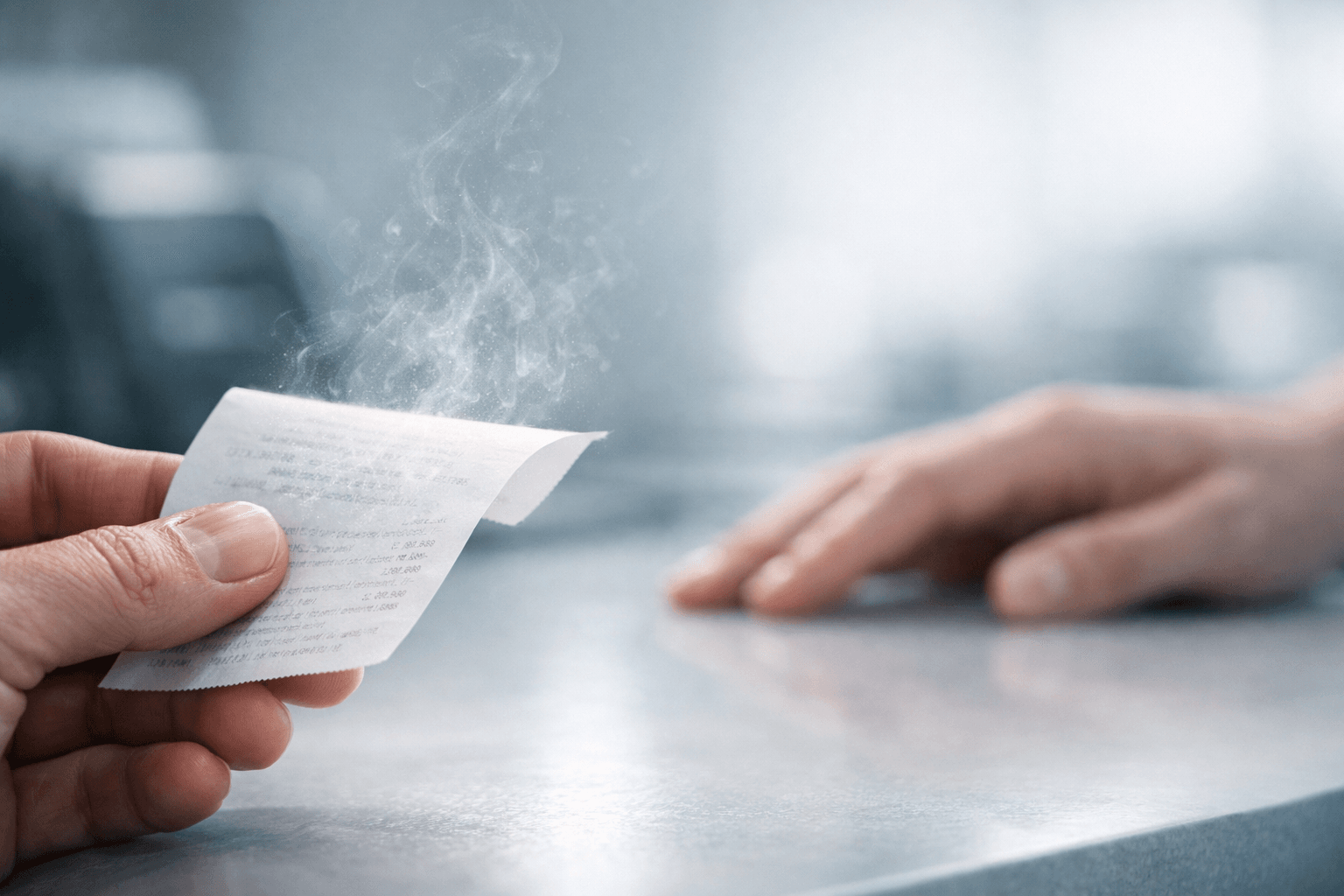
Why a 5-second habit change can meaningfully cut everyday chemical exposure to BPA and BPS.
Receipts seem harmless. But the thin, shiny paper you touch at the checkout is one of the most concentrated sources of bisphenol exposure in daily life. The good news is this is also one of the easiest exposures to reduce, starting today.
Key Takeaways
- Thermal receipts contain free BPA or BPS on the surface, not locked inside plastic.
- Hand sanitizer, lotion, or sunscreen massively increases skin absorption.
- Cashiers and hospitality workers face much higher cumulative exposure.
- BPS has largely replaced BPA and may be just as hormonally active.
- Digital receipts and small handling habits sharply reduce risk.
What’s Actually in Thermal Paper
🧾 Thermal receipts are printed using heat-reactive coatings. To make the text appear, manufacturers commonly use bisphenols like BPA or BPS as chemical developers.
Here’s the key detail most people miss:
These bisphenols are not chemically bound to the paper. They sit loosely on the surface, ready to transfer with touch.
📊 A 2025 analytical survey of receipts in Turkey found BPA or BPS in nearly all samples, with some exceeding 1,000 µg per gram of paper. That’s an extremely high surface concentration for a substance known to interact with hormones.
How BPA Transfers to Your Body
✋ Studies consistently show that bisphenols move easily from receipt → skin → bloodstream.
- Dry hands transfer smaller amounts.
- Wet, greasy, or lotioned hands transfer much more.
- Alcohol-based hand sanitizers act as penetration enhancers.
👉 In other words, sanitizer doesn’t protect you here. It does the opposite.
This matters because sanitizer use often happens right before handling receipts at stores, cafes, airports, and pharmacies.
Human Evidence: BPA Absorption Is Real
🔬 The most cited real-world experiment comes from a controlled human study published in PLOS ONE.
Study design (realistic and uncomfortable):
- Participants applied hand sanitizer
- Held a BPA-coated receipt
- Then touched food
What happened next was telling:
- BPA levels on skin skyrocketed
- Unconjugated BPA (the biologically active form) rose in blood
- Urinary BPA increased shortly after
⏱️ Serum BPA increased within ~90 minutes.
👉 This combination of dermal + oral exposure bypasses first-pass liver metabolism, meaning more active BPA circulates in the body.
How Bad Are Real-World Receipts?
🌍 A 2023 global sampling study analyzed receipts from multiple countries.
Key findings:
- ~60% exceeded the EU’s 200 ng/mg safety benchmark
- Some receipts contained orders of magnitude more BPA than recommended limits
📌 The benchmark comes from European Union regulations. Not all countries enforce similar limits, and imported paper can still circulate widely.
BPA Substitutes: Why BPS Isn’t the Solution
🚨 As BPA faced restrictions, manufacturers pivoted to BPS.
Unfortunately:
- BPS is structurally similar
- It shows comparable endocrine-disrupting activity
- It’s now widespread in receipts and recycled paper
🧪 A 2025 consumer exposure analysis estimated that holding a BPS receipt for ~10 seconds could exceed a conservative safety threshold under certain conditions.
“BPA-free” does not mean bisphenol-free.
Who Is Most Affected
👩💼 Cashiers, baristas, ticketing staff, and retail workers handle hundreds of receipts per shift.
Biomonitoring data shows:
- Higher internal bisphenol levels in occupationally exposed workers
- Risk driven by frequency and cumulative contact, not single events
This turns a small exposure into a chronic one.
Health Context: Why Bisphenols Matter
🧠 BPA and BPS are classified as endocrine-disrupting chemicals (EDCs).
Mechanistic and animal data link them to:
- Reproductive effects
- Developmental changes
- Metabolic disruption
- Immune effects
- Potential cancer-related pathways
Human data is still evolving, but regulatory agencies treat bisphenols cautiously because hormonal systems are exquisitely sensitive, especially during pregnancy and childhood.
Actionable Tips You Can Use Today
Before touching receipts
🙌 Avoid hand sanitizer, lotion, sunscreen, or creams right beforehand
✔️ Dry, clean hands reduce absorption
While handling
- Use fingertips only, not palms
- Ask for digital receipts whenever possible 📱
- Keep receipts away from food, phones, wallets, and kids’ items
After contact
🚿 Wash hands with soap and water before eating or touching your face
For workers
- Use nitrile or barrier gloves during long shifts
- Prefer alcohol-free cleansers
- Ask employers about bisphenol-free thermal paper
For parents
🧒 Never give receipts to children
⏳ After applying sunscreen or lotion, delay receipt handling
Bottom Line
Thermal receipts are a small but unusually concentrated source of hormone-active chemicals. You don’t need fear or perfection here. Just awareness.
This is one of the rare exposures that’s cheap, fast, and mostly optional to reduce.
Sources
- BPA/BPS Exposure Analysis in Thermal Paper
https://pubs.rsc.org/en/content/articlelanding/2025/va/d4va00132j - Holding Thermal Receipt Paper and Eating Food after Using Hand Sanitizer…
https://journals.plos.org/plosone/article?id=10.1371/journal.pone.0110509 - Detection of Bisphenol A in Thermal Paper Receipts
https://journals.plos.org/plosone/article?id=10.1371/journal.pone.0283675