Animal studies reveal how a natural molecule targets cells that refuse to die and what it means for human healthspan.
Your body is carrying millions of cells that should have died years ago. They no longer divide, they pump out inflammatory signals, and they slowly poison the tissue around them. Scientists call them senescent cells. Most people now call them zombie cells.
And in a series of studies published between 2021 and 2025, researchers found that a grape seed compound might help remove them. At least in animals.
This is not a miracle. But it is one of the most convincing senolytic stories we have right now.
Key Takeaways
- Procyanidin C1 (PCC1) from grape seeds selectively kills senescent “zombie” cells in animals
- Aged mice moved better, had less inflammation, and healthier tissues
- Benefits span eyes, immune system, muscles, and skin
- No human trials yet. This is healthspan research, not immortality science
- Eating grapes or taking random supplements will not replicate these effects
The Zombie Cell Problem
🛡️As you age, more cells enter senescence. This is supposed to be protective. Cells stop dividing so they don’t become cancerous.
Instead of dying, these cells stick around. They release inflammatory molecules known as the SASP. Over time, this creates a toxic environment that damages nearby healthy cells.
Think of senescent cells as coworkers who refuse to quit, refuse to work, and constantly complain. Eventually, the whole office slows down.
Researchers now link senescent cell buildup to joint degeneration, immune decline, metabolic disease, cognitive aging, and frailty. Clearing them out has become one of the hottest targets in aging biology.
Enter Procyanidin C1
🍇 Grape seeds are rich in proanthocyanidins, compounds long marketed as antioxidants. But one molecule stood out.
Procyanidin C1 (PCC1).
In a landmark 2021 paper published in Nature Metabolism, researchers showed that PCC1 acts as a senolytic, meaning it actively kills senescent cells while sparing healthy ones.
Mice treated intermittently with PCC1:
- Performed better physically
- Showed reduced inflammation
- Lived longer than untreated peers
That alone was impressive. But the real story came later.
The 2024–2025 Evidence Wave
Over the last two years, multiple independent labs tested PCC1 across different tissues. The pattern was hard to ignore.
Study 1: Eye Health (2024)
👁️ Published in Proceedings of the National Academy of Sciences, researchers treated naturally aged mice with PCC1.
Results:
- Improved retinal structure
- Better visual function
- Reduced inflammatory signaling
Using single-cell RNA sequencing, scientists showed PCC1 both removed senescent cells and quieted the inflammatory ones that remained. That dual action matters.
Study 2: Immune System (2025)
💪 A 2025 study in npj Aging focused on bone marrow and spleen tissue.
PCC1 treatment:
- Suppressed senescence markers
- Reduced chronic immune inflammation
- Improved grip strength in aged mice
Grip strength is one of the strongest predictors of biological aging. When immune health and muscle function improve together, researchers pay attention.
Study 3: Skin Aging (2025)
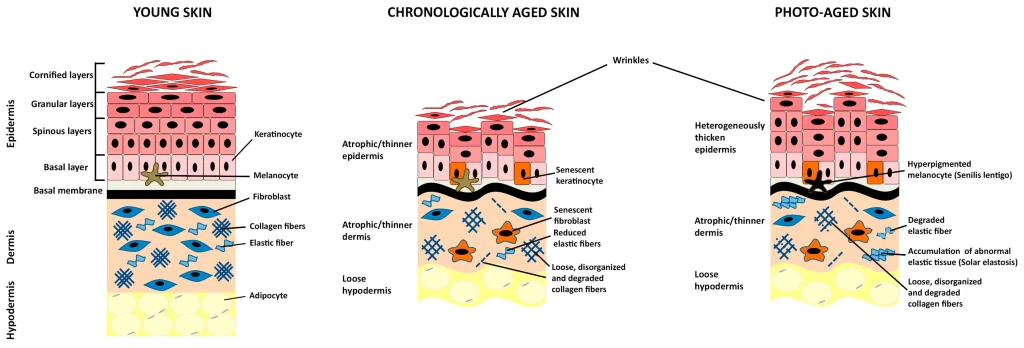
✨ The newest study looked at skin fibrosis and fibroblast senescence.
Fibrosis is excess scar tissue. It stiffens skin and accelerates visible aging.
PCC1:
- Reduced fibroblast senescence
- Lowered fibrotic signaling
- Improved tissue structure
This suggests PCC1’s effects are not limited to internal organs. Aging is systemic, and so is senescence.
How PCC1 Works
Senescent cells survive because they activate anti-apoptotic defenses. Basically, they block the self-destruct button.
PCC1 appears to override those defenses.
- At higher doses, it triggers apoptosis in senescent cells
- At lower doses, it dampens inflammatory output
🔬 This is why studies use intermittent dosing. You don’t want constant cell death. You want periodic cleanups that allow tissues to recover. It’s precision demolition, not carpet bombing.
What This Does Not Mean
Let’s shut down the hype now.
- Eating grapes won’t do this. PCC1 levels in food are tiny
- Most grape seed supplements do not contain isolated PCC1
- Mouse success does not equal human success. About 90% of rodent interventions fail in people
- Zero human trials exist as of 2025
This is early-stage biology, not a longevity shortcut.
The Bigger Senolytic Landscape
PCC1 joins a fast-growing senolytic toolbox:
- Dasatinib + quercetin: tested in small human trials
- Fisetin: promising but inconsistent
- Genetic clearance models: powerful, impractical
What makes PCC1 stand out is its breadth. Eyes. Immune system. Muscle. Skin. And both senolytic and senomorphic effects.
When Could This Become Real? ⏳
For PCC1 to matter clinically, we need:
- Human safety and dosing trials
- Bioavailability data
- Long-term intermittent use studies
- Standardized formulations
Best-case timeline: 5 to 10 years.
What You Can Do Right Now
While the research matures:
- Exercise regularly. It’s the most reliable anti-senescence tool we have
- Sleep deeply. Poor sleep accelerates cellular aging
- Eat protein and micronutrients to support tissue repair
- Be skeptical of supplements promising “cellular cleanup”
Healthspan gains are built slowly, not hacked overnight.
The Bottom Line
Zombie cells are real. Senolytics are real. And Procyanidin C1 is one of the most convincing natural senolytics ever tested in animals.
But we’re still early.
This research doesn’t mean radical life extension. It suggests something more realistic and more valuable: aging might be partially improvable.
Less inflammation. Better function. Stronger years at the end of life.
Sources
- The flavonoid procyanidin C1 has senotherapeutic activity and increases lifespan in mice
https://www.nature.com/articles/s42255-021-00491-8 - Senolytic and senomorphic agent procyanidin C1 alleviates structural and functional decline in the aged retina
https://doi.org/10.1073/pnas.2311028121 - Single-cell profiling unveils a geroprotective role of Procyanidin C1 in hematopoietic immune system
https://doi.org/10.1038/s41514-025-00222-3 - Procyanidin C1 ameliorates aging-related skin fibrosis and fibroblast senescence
https://www.sciencedirect.com/science/article/abs/pii/S0944711325004258